
Radio, TikTok, and the Disappearing Classic
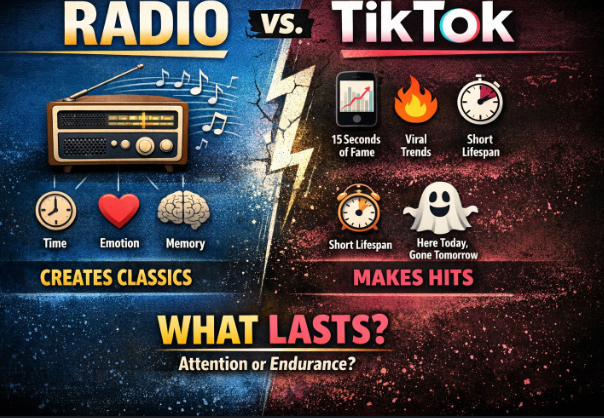
We’ve never had more hits.
And we may be losing the songs that last.
That’s the tradeoff no one is talking about in 2026.
TikTok is now the most powerful music discovery engine in the world. Songs don’t build anymore—they explode. A 15-second clip, a dance, a meme… and suddenly a track from last week—or 40 years ago—is everywhere again.
It’s impressive.
It’s also changing what a “hit” means.
Because TikTok is incredibly good at creating attention.
But attention isn’t the same as endurance. A song can go viral in days. It can also disappear just as quickly.
Which raises a bigger question:
If TikTok decides what’s popular… who decides what lasts?
That used to be radio.
Radio didn’t just play hits—it made classics. Not by accident, but by design.
A song became a classic through a simple but powerful chain:
Repetition → Recognition → Emotion → Memory
And radio controlled all of it.
It stayed with songs long after their chart peak. It moved them from currents to recurrents to gold. It reintroduced them to new generations. Most importantly, it did this at scale—creating something no algorithm can fully replicate:
Shared experience.
Everyone heard the same songs. At the same time. In the same cultural moment.
That’s how music became part of people’s lives—not just their feeds.
Today, that system is under pressure.
Streaming has personalized everything. TikTok has fragmented it. And radio, in many cases, has stepped back from its original role.
Instead of building songs over time, it often:
Waits for TikTok to validate them
Rotates them aggressively
Moves on just as quickly
Which leads to an uncomfortable truth:
Radio isn’t losing because of TikTok.
Radio is choosing not to play the long game anymore.
And that has consequences.
Because when everything is a hit… nothing lasts.
TikTok creates moments.
Radio used to create memory.
That’s the difference.
And it’s also the opportunity.
Because radio still has something incredibly valuable—something no platform has fully replaced:
The ability to turn songs into shared, emotional experiences over time.
But that only happens if it commits to:
Staying with songs longer
Giving them context through great air talent
Reintroducing them with purpose—not just filling “gold” slots
Creating moments where audiences experience music together again
Not chasing what’s trending…
But deciding what’s worth remembering.
Because in the end, TikTok can absolutely make a hit. But a classic?
That still requires time.
Repetition.
Emotion.
And a platform willing to believe a song matters after the trend fades.
The real question isn’t whether TikTok is powerful.
It is.
The real question is this:
Does radio still want to create songs that last?
Dave Van Dyke
dvd@bridgeratings.com